Polonnaruwa
The Golden Age Capital of Ancient Sri Lanka
Step into the grandeur of medieval Sri Lanka at Polonnaruwa, the magnificent ancient capital that flourished as the island's political and cultural heart for over two centuries. This UNESCO World Heritage Site spans 122 square kilometers of extraordinary archaeological treasures, where colossal Buddha statues carved from solid granite stand sentinel over palace ruins, sophisticated irrigation systems, and architectural marvels that showcase the golden age of Sinhalese civilization. More than just ruins, Polonnaruwa is a living testament to human achievement which is a place where ancient kings built a paradise of stone and water that continues to inspire awe nearly a millennium later.
What Makes Polonnaruwa Extraordinary
Polonnaruwa represents the pinnacle of ancient Sri Lankan civilization, where three great kings Vijayabahu I, Parakramabahu I, and Nissanka Malla transformed a strategic location into one of Asia's most advanced medieval cities. This isn't merely an archaeological site; it's an entire ancient metropolis preserved in stone, featuring the world's most impressive group of rock-carved Buddha statues, palace complexes that rival Angkor Wat in sophistication, and irrigation engineering so advanced it supplied water to over 3,000 acres of agricultural land. The scale is breathtaking: massive stupas that dwarf most modern buildings, intricately carved moonstone entrances that represent the cycle of life, and sacred quadrangles where monks once gathered in numbers that could fill a modern stadium. Exploring Polonnaruwa means walking through streets where medieval kings held court, standing before artistic masterpieces that have survived centuries of monsoons and invasions, and witnessing the extraordinary ambition of a civilization that created beauty and functionality on an almost unimaginable scale.
Historical Significance
Polonnaruwa's golden era began in 1070 CE when King Vijayabahu I established it as the new capital after driving out the Chola invaders who had occupied Anuradhapura. But it was under King Parakramabahu I (1153-1186 CE) that the city reached its zenith, becoming the undisputed center of a unified Sri Lanka that extended its influence across the Indian Ocean. Parakramabahu's vision was extraordinary: he created the massive Parakrama Samudra (Sea of Parakrama), a 2,400-hectare reservoir that still supplies water today, while constructing palaces, temples, and hospitals that served a population of over 100,000 people. His famous declaration, "Let not even a drop of rain water go to the sea without being made useful to man," transformed the landscape through irrigation systems so sophisticated they're studied by modern engineers. When Nissanka Malla succeeded him, he added his own architectural marvels, including the famous rock inscriptions that provide intimate glimpses into royal court life. The city thrived until invasions from South India in the 13th century forced the capital to move south, leaving Polonnaruwa to be gradually reclaimed by jungle until British archaeologists began serious excavations in the 19th century. Today, Polonnaruwa stands as testament to human creativity, ambition, and the eternal desire to build something extraordinary that defies both time and nature.
Must-Experience Wonders
Gal Vihara - The Ultimate Rock Temple
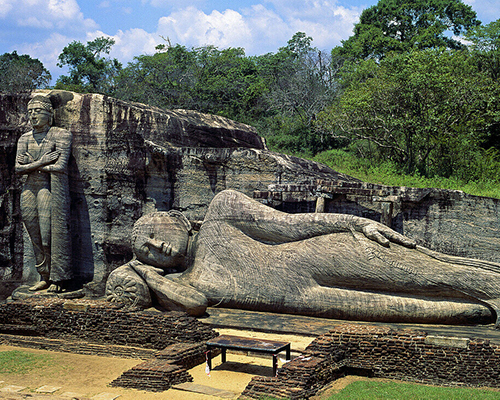
The crown jewel of Polonnaruwa, this magnificent cavern features four colossal Buddha statues carved from a single granite outcrop that represent the pinnacle of ancient Sinhalese sculpture. The 46-foot standing Buddha displays perfect proportions and serene expression that changes subtly with the light throughout the day, while the 46-foot reclining Lord Buddha depicts the moment of passing into Nirvana with extraordinary detail which is from the lotus cushion beneath his head to the slight smile suggesting peaceful transcendence. The seated meditation Buddha and the smaller standing figure complete this masterpiece that took decades to complete, with each statue displaying unique facial features, hand positions, and robing styles that demonstrate the sculptors' mastery of their craft.
The Royal Palace Complex - Parakramabahu's Vision
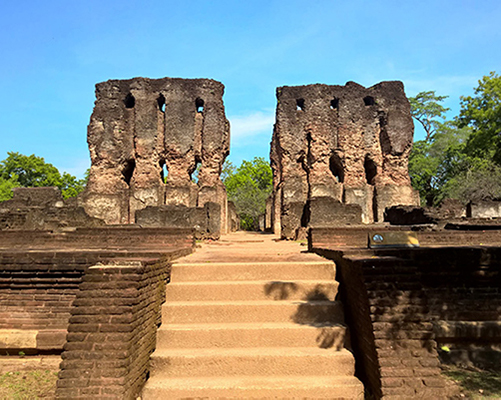
Explore the remains of what was once a seven-story palace complex that housed the most powerful monarch in Sri Lankan history. The Royal Palace foundations reveal a structure covering 31 meters by 13 meters, with walls that once soared 30 meters high. The nearby Council Chamber, with its beautifully carved stone lions and elephant sculptures, hosted diplomatic meetings with envoys from across Asia. The Royal Bath, fed by sophisticated hydraulic systems, features stepped sides and drainage systems that demonstrate the luxury and engineering prowess of medieval royal life. Nearby, discover the King's Council Chamber with its carved stone lions that once supported a wooden roof, and the Audience Hall where subjects presented petitions to their monarch.
Quadrangle (Dalada Maluwa) - The Sacred Heart
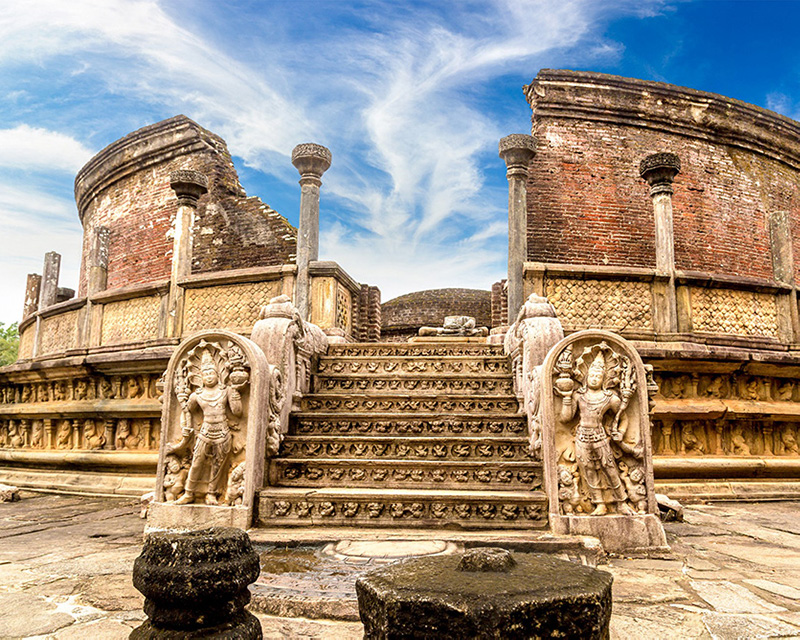
This compact but extraordinary complex contains the most important religious buildings of ancient Polonnaruwa, including the Hatadage, which once housed the sacred Tooth Relic of the Buddha. The Vatadage, a unique circular relic house with concentric terraces of carved stone, represents architectural innovation found nowhere else in the world. Its four Buddha statues face the cardinal directions, surrounded by intricately carved guard stones and moonstones that symbolize the path to enlightenment. The Thuparama Gedige, the only completely intact building in Polonnaruwa, showcases the distinctive Polonnaruwa architectural style with its thick walls and corbelled roof construction that has withstood centuries of weathering.
Parakrama Samudra - The Engineering Marvel
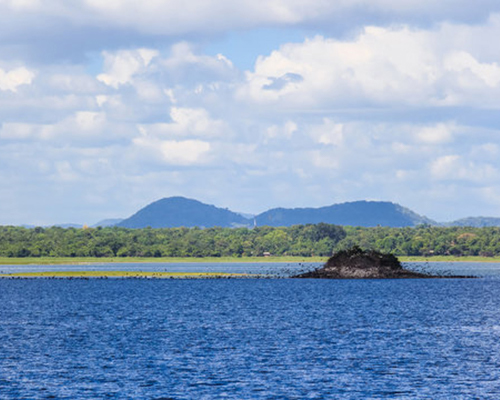
King Parakramabahu's greatest achievement, this massive artificial lake covers 2,400 hectares and demonstrates hydraulic engineering that remained unmatched until modern times. The reservoir, created by damming several rivers and streams, supplied water to over 18,000 acres of rice fields through a network of canals, locks, and smaller tanks. The main bund (dam) stretches for 8.5 miles and incorporates sophisticated spillway systems that prevent overflow during monsoons. Today, the lake continues to supply irrigation water to surrounding agricultural areas while providing habitat for hundreds of bird species and creating spectacular sunset views that reflect the ancient stupas along its shores.
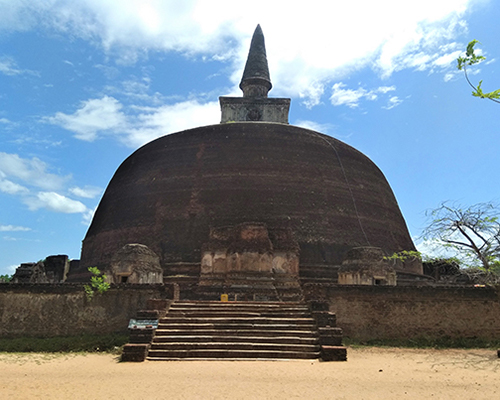
Rankot Vihara - The Golden Pinnacle Stupa
Standing 180 feet tall, this massive brick stupa is the largest in Polonnaruwa and fourth largest in Sri Lanka, representing the architectural ambitions of King Nissanka Malla. Built in the shape of a perfect bell, the stupa required millions of bricks and demonstrates construction techniques that allowed ancient builders to create structures of remarkable stability and proportion. The surrounding complex includes ruins of monks' quarters, meditation halls, and smaller shrines that housed a monastic community of hundreds. Climbing the terraced base provides panoramic views across the ancient city and reveals the sophisticated urban planning that made Polonnaruwa a model medieval metropolis.
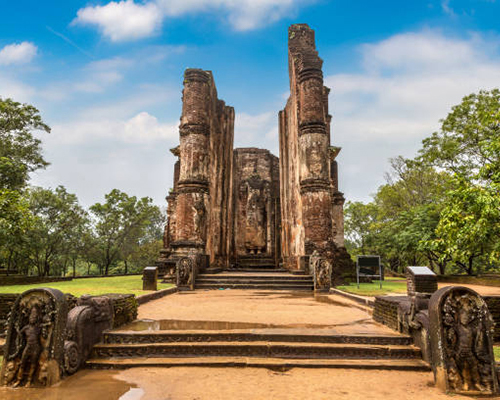
Lankatilaka Gedige - The Towering Temple
This massive temple structure, rising 58 feet high with walls 11 feet thick, houses a headless standing Buddha statue that once stood 41 feet tall. The building represents a unique architectural style that combines South Indian and Sinhalese elements, with its towering walls creating a cathedral-like atmosphere that focuses attention on the colossal Buddha figure. The structure's preservation demonstrates ancient building techniques designed to withstand both earthquakes and monsoons, while intricate carvings on doorways and walls reveal the artistic sophistication of Polonnaruwa's craftsmen.
Cultural Experiences & Living Heritage
Traditional Craft Demonstrations
Observe master craftsmen demonstrating traditional stone carving, bronze casting, and temple painting techniques similar to those used by ancient artisans. Local workshops continue centuries-old traditions, creating religious sculptures and decorative elements using period-appropriate tools and methods. Many artisans learned their skills from family traditions passed down through generations of temple builders.
Transportation & Access from Major Cities
From Colombo
216 km via A1 and A11 highways (4-5 hours), ideal for Cultural Triangle circuits.
From Kandy
140 km via scenic A9 route (3.5 hours), perfect for combining hill country with ancient sites.
From Anuradhapura
104 km via A12 highway (2.5 hours), excellent for same-day twin ancient capital exploration.
From Sigiriya
70 km via local roads (1.5 hours), most popular combination for archaeological enthusiasts.
From Dambulla
50 km via A6 highway (1 hour), convenient for temple cave combinations.
Dining Experiences
Village Home Cooking
Authentic meals prepared by local families using traditional clay pots and wood-fired stoves.
Lakeside Dining
Restaurants overlooking Parakrama Samudra with views of ancient stupas reflected in water.
Archaeological Park Cafes
Simple but fresh local food served near major monument clusters.
Heritage Hotel Cuisine
Refined presentations of traditional recipes using locally sourced ingredients.
Sunset Picnics
Organized outdoor dining experiences with views of illuminated ancient monuments.
Authentic Shopping & Souvenirs
Local Crafts & Art
Miniature Stupa Models
Hand-crafted replicas of famous Polonnaruwa monuments using traditional techniques.
Stone Carving Reproductions
Skilled artisans create miniature versions of famous guard stones and moonstones.
Traditional Metalwork
Bronze and brass items crafted using ancient lost-wax casting methods.
Handwoven Textiles
Village-produced fabrics featuring traditional patterns and natural dyes.
Wooden Buddha Statues
Carved representations of the famous Gal Vihara sculptures in various sizes.
Cultural Artifacts
Traditional Manuscripts
Palm leaf replicas featuring ancient Buddhist teachings and historical texts.
Archaeological Publications
Specialized books and guides written by researchers working at the site.
Heritage Seeds
Traditional rice varieties and other indigenous plants cultivated using ancient agricultural methods.
Natural Gemstones
Semi-precious stones found in the region, crafted into traditional jewelry designs.
Best Times to Visit & Seasonal Highlights
Optimal Climbing Conditions
Early Morning (6:00-9:00 AM)
Cool temperatures for cycling, perfect lighting for photography, peaceful atmosphere.
Late Afternoon (3:30-6:00 PM)
Golden hour illumination of monuments, comfortable temperatures, dramatic sunset views.
Dry Season (May-September)
Clear skies for optimal visibility, stable weather for extended exploration.
Cool Season (December-February)
Most comfortable temperatures for extensive archaeological site touring.
Seasonal Considerations
Monsoon Season (October-November)
Occasional afternoon showers but lush green landscapes and fewer crowds.
Peak Season (December-March)
deal weather conditions but require early morning visits for solitude.
Hot Season (March-May)
Extreme temperatures requiring very early starts and frequent hydration breaks.
Visitor Guidelines & Practical Information
Entry Requirements & Logistics
Site Coverage
Allow full day for comprehensive exploration; minimum 4-6 hours for major highlights.
Physical Requirements
Moderate walking ability required; extensive site covers several kilometers.
Age Suitability
Appropriate for all ages with proper planning and hydration.
Safety & Preparation Guidelines
Sun Protection
Essential for extended outdoor exploration; hat, sunscreen, and protective clothing required.
Hydration
Carry ample water; tropical climate and extensive walking require constant fluid replacement.
Footwear
Comfortable walking shoes with good grip; some areas involve uneven ancient stone surfaces.
Weather Preparation
Light rain protection during monsoon months; umbrella useful for both sun and rain.
Cultural Respect & Photography Ethics
Dress Code
Modest clothing covering shoulders and knees required at all religious sites.
Photography Guidelines
Respectful photography permitted; flash photography prohibited near ancient paintings.
Behavioral Expectations
Maintain quiet, respectful demeanor; avoid climbing on ancient structures.
Environmental Responsibility
Stay on designated paths; carry out all trash to preserve archaeological integrity.
Insider Tips from Dream Lanka Holidays
Hidden Gems & Secret Spots
Tivanka Image House
Often overlooked temple containing the best-preserved ancient frescoes in Polonnaruwa.
Kiri Vehera
Perfectly preserved white stupa offering peaceful contemplation away from main tourist circuits.
Ancient Hospital Ruins
Fascinating glimpse into medieval medical practices and pharmaceutical preparations.
Professional Photography Secrets
Weather Windows
Brief clear periods during monsoon provide the most dramatic lighting conditions.
Cultural Sensitivity
Always respect religious sites; many locals appreciate sharing historical knowledge.
Technical Considerations
High contrast between bright stone and deep shadows requires careful exposure management.
Comprehensive FAQ
Experience Polonnaruwa with Dream Lanka Holidays
Journey through eight centuries of history with our expert guides who transform ancient ruins into vivid stories of kings, monks, and craftsmen who created one of Asia's greatest medieval cities. Our specialized Polonnaruwa experiences combine archaeological expertise with cultural immersion, ensuring you understand not just what you're seeing, but why it represents humanity's extraordinary capacity for beauty, innovation, and spiritual achievement.
We provide exclusive access to ongoing research projects, connections with leading archaeologists, and timing strategies that reveal Polonnaruwa's monuments in optimal lighting conditions away from crowds. Our guides, trained in both historical accuracy and storytelling artistry, help you visualize the bustling medieval metropolis that once thrived where ruins now stand in magnificent solitude.
From practical details like optimal cycling routes to profound insights about Buddhist philosophy and ancient engineering, let Dream Lanka Holidays guide you through Polonnaruwa's treasures. Experience the golden age of Sri Lankan civilization where every carved stone tells a story, every monument reflects extraordinary ambition, and every pathway connects you to the dreams and achievements of one of history's most sophisticated ancient cultures.